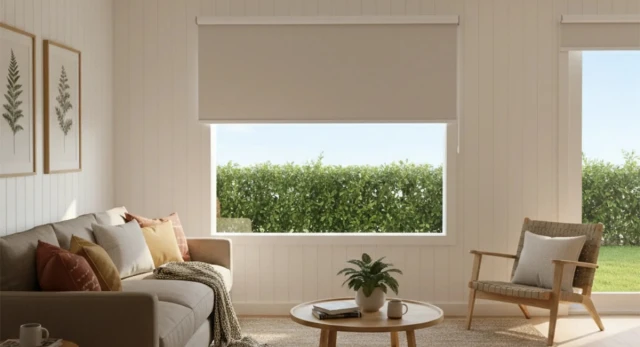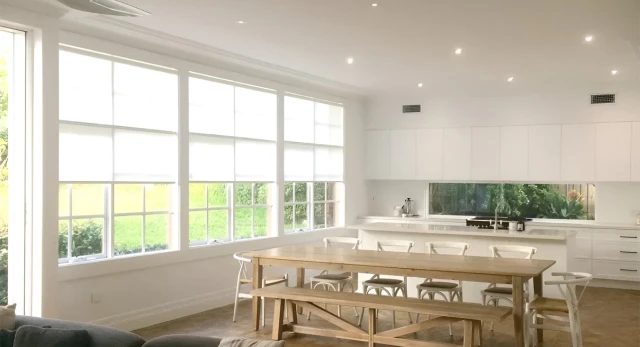
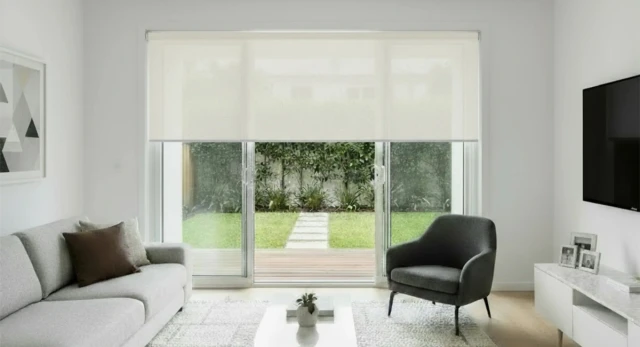
A practical iSeekBlinds guide to choosing, sizing and motorising roller blinds for wide windows, sliding doors and large glass openings
Large windows bring natural light, views and a stronger connection to outdoor areas, but they also create practical challenges. A larger expanse of glass can mean more glare, heat and privacy to manage, as well as a heavier blind that needs to move reliably every day.
Motorisation makes these blinds easier to operate by remote or compatible smart-home control, while linked roller blinds divide extra-wide openings into manageable sections. The correct solution may be a single or linked blind, RollerIQ or Automate Zero Li-ion, and blockout, sunscreen or light-filtering fabric. Mounting position, door layout, control method and the location of the gaps should all be decided before ordering.
This guide explains how to make those choices using the current iSeekBlinds motorised roller blind range.
1. Why Large Windows Benefit from Motorisation
Large roller blinds are heavier than small blinds.
The larger the blind, the more fabric and tube weight the system needs to move.
Manual chain control can still work well. But motorisation becomes increasingly practical as the blind gets larger.
Remote or compatible smart-home control removes the need to repeatedly operate a long chain on a large blind.
Motorisation is particularly useful for:
- •
Large living room windows
- •
Sliding doors
- •
Stacking doors
- •
Wide bedroom windows
- •
Open-plan living areas
- •
Floor-to-ceiling glazing
- •
Windows positioned behind furniture
The main benefit is reliable, convenient everyday operation.
A large blind is more likely to be used consistently when opening and closing it is simple.
2. Current iSeekBlinds Motor Options
The current iSeekBlinds motorised range should be considered around two main options:
- •
RollerIQ
- •
Automate Zero Li-ion
Both systems are rechargeable and remove the need for a hanging chain. RollerIQ is designed for compatible smart-home control, while Automate Zero Li-ion is operated by remote and can gain additional smart features through optional compatible equipment.
For a complete overview, read the Complete Guide to Motorised Blinds .
3. RollerIQ for Large Windows
RollerIQ is iSeekBlinds' smart motor option.
It uses Matter over Thread and is designed to work with compatible smart-home platforms.
This makes it particularly useful for large windows that you want to operate as part of everyday routines.
For instance:
- •
Open living room blinds in the morning.
- •
Lower west-facing blinds before strong afternoon sun.
- •
Close large bedroom blinds at sunset.
- •
Include blinds in evening privacy scenes.
- •
Use voice control where supported.
RollerIQ is available for suitable blinds up to 3,000 mm wide.
That makes it a practical option for many large single-window applications.
The main benefit is not simply that the blind moves automatically.
It is that large windows become easier to manage consistently.
4. Automate Zero Li-ion for Large Windows
Automate Zero Li-ion is the iSeekBlinds remote-controlled motor option.
It is available in different motor sizes based on blind width.
Current iSeekBlinds sizing uses:
- •
Automate Zero Li-ion Q1.1 for widths from approximately 570 mm to 2,000 mm
- •
Automate Zero Li-ion Q2.0 for widths from 2,001 mm to 3,000 mm
The larger Q2.0 motor is suited to wider blinds that need the motor capacity specified for the wider blind.
Automate Zero Li-ion is a strong choice when you want:
- •
Reliable motorised operation
- •
Remote control
- •
Multiple blinds on one compatible remote
- •
Optional compatible hub control
- •
A simpler setup than a full smart-home system
For households that prefer uncomplicated control, this may be all that is required.
5. How Wide Can a Single Motorised Blind Be?
The current iSeekBlinds motorised roller blind range supports suitable single blinds up to approximately 3,000 mm wide.
That is a large blind. For many windows, one blind will provide the cleanest finish.
A single blind can make sense when:
- •
The opening is within the supported width.
- •
There is one clear pane or opening.
- •
You want one continuous fabric surface.
- •
There is no door section that needs independent access.
- •
The blind can be measured and installed correctly.
Once the total opening becomes wider than the practical single-blind limit, linked roller blinds become the more appropriate solution.
6. What Happens When the Window Is Wider Than 3,000 mm?
For windows wider than 3,000 mm, iSeekBlinds offers Linked Roller Blinds .
Instead of trying to manufacture one oversized blind, the opening is divided into two individual roller blinds.
Each blind can be up to approximately 3,000 mm wide.
The combined linked system can cover up to approximately 6,000 mm overall.
This makes linked roller blinds particularly useful for:
- •
Wide sliding doors
- •
Stacking doors
- •
Large living room windows
- •
Open-plan spaces
- •
Wide bedroom windows
- •
Large glazed openings
This approach respects the product limits and gives each blind a more manageable span.
7. How Linked Roller Blinds Work
Linked roller blinds use two blinds positioned side by side with a linking bracket system between them.
The linking system reduces the centre gap compared with two completely separate blinds.
iSeekBlinds currently describes the centre gap as being reduced from around 32 mm to as little as approximately 19 mm based on the configuration.
Each blind still operates independently.
That means you can:
- •
Open one side.
- •
Close the other.
- •
Adjust both separately.
- •
Motorise both blinds.
- •
Use different positions throughout the day.
Independent control is especially useful across sliding doors, where access and shading needs can change through the day.
One section can stay raised for access while the other manages sunlight or privacy.
8. Motorising Linked Roller Blinds
Motorisation works particularly well with linked blinds. Each individual blind can have its own motor.
This gives you more flexibility than treating the whole opening as one large moving surface.
For instance:
- •
Left blind open.
- •
Right blind closed.
- •
Both open.
- •
Both closed.
- •
One partially lowered.
This can be useful when sunlight only reaches one side of the room.
It also makes large openings easier to manage.
Instead of operating two large blinds manually, you can control them from a remote or compatible smart-home system.
9. RollerIQ or Automate Zero Li-ion for Linked Blinds?
Both can work well.
Choose RollerIQ when you want:
- •
Smart-home integration
- •
App control through a compatible platform
- •
Voice control where supported
- •
Schedules
- •
Scenes
- •
Automated privacy routines
- •
Automated sun-control routines
Choose Automate Zero Li-ion when you want:
- •
Remote control
- •
Straightforward operation
- •
Reliable rechargeable motors
- •
Multiple blinds controlled from a compatible remote
- •
Optional hub-based control where required
The most suitable option is determined by how you want to use the room.
Do not choose the most advanced system simply because it exists.
Choose the control method you will actually use.
10. Large Sliding Doors
Sliding doors are one of the most common applications for large motorised blinds.
They create a wide glass area. They may also need to remain accessible throughout the day.
A linked system can work well because the blinds can follow the door layout.
For instance:
- •
One blind over the fixed glass.
- •
One blind over the sliding panel.
This allows the blind over the door opening to be raised while the other remains lowered.
That flexibility is difficult to achieve with one very large blind.
Motorisation makes the setup even easier.
11. Stacking Doors and Bi-Fold Openings
Stacking and bi-fold doors may create even wider openings. Before ordering blinds, look carefully at how the doors operate.
Ask:
- •
Which sections move?
- •
Which sections remain fixed?
- •
Where are the handles?
- •
Where should the centre bracket sit?
- •
Which blind should operate independently?
Plan the blind divisions around the way the doors and fixed panels are actually used.
Visual balance matters, but it should never make the doorway awkward to use.
Function comes first. Then visual symmetry.
12. Large Living Room Windows
Large living room windows often need different control throughout the day.
Morning light may be welcome. Afternoon sun may become uncomfortable. Evening privacy may become important. Motorisation makes those changes easier.
You can open the blinds fully when you want the view.
Lower them when glare becomes uncomfortable. Close them at night.
For smart-home users, these changes can also be built into routines.
Large blinds benefit from consistency because the window has such a strong effect on the room.
13. Large Bedroom Windows
Wide bedroom windows can look impressive. But they also bring in a lot of morning light.
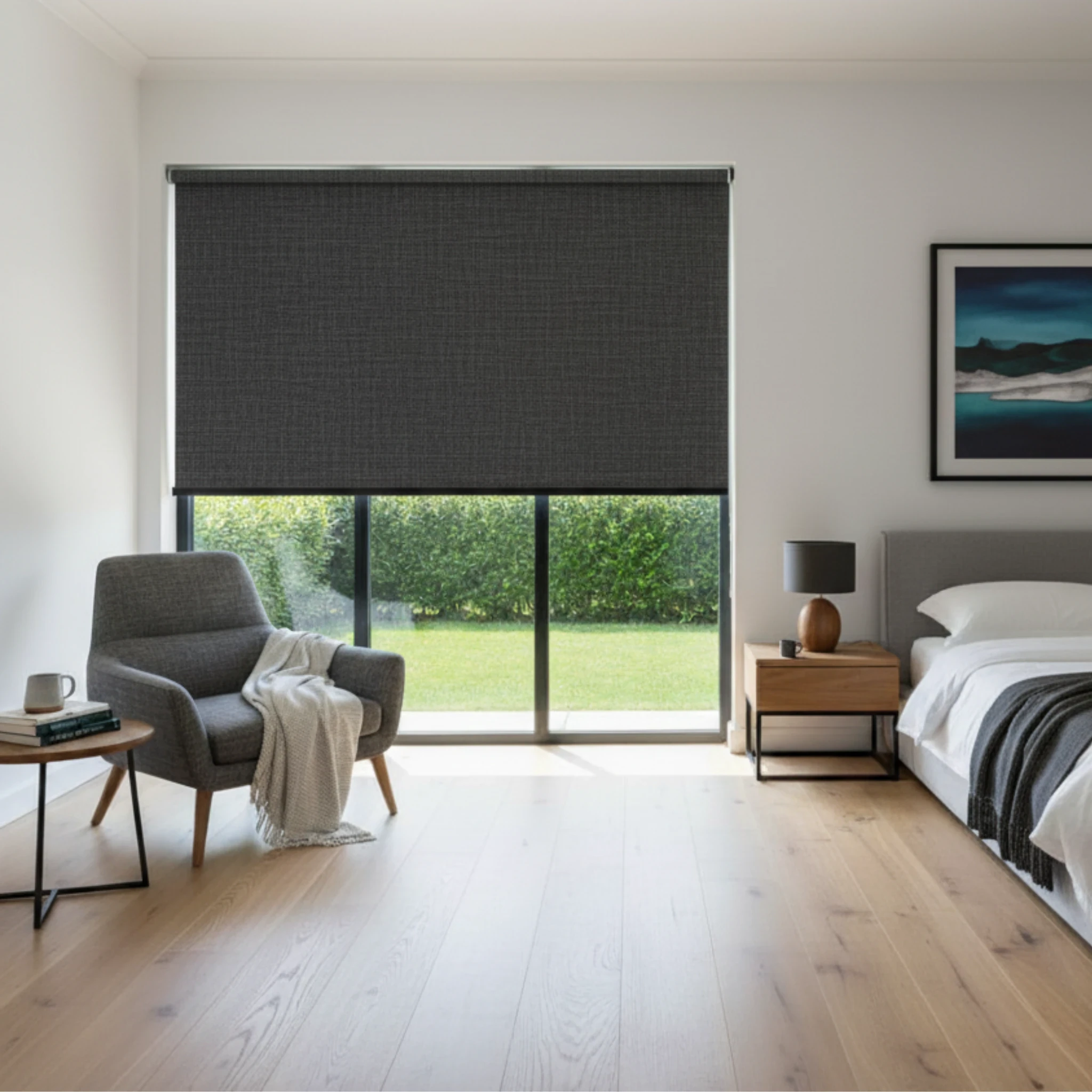
For bedrooms, Blockout Roller Blinds are usually the strongest choice where darkness and privacy matter.
Motorisation can make them easier to use every day. Open in the morning. Close at bedtime.
For large windows, that simple routine can be far more convenient than manually operating a heavy blind.
If the opening is wider than a single blind can handle, linked blockout blinds can divide the window into manageable sections.
14. Large Windows and Sunscreen Fabric
Sunscreen Roller Blinds are particularly useful across large living room windows and doors.
Large glass areas often create:
- •
Glare
- •
UV exposure
- •
Heat
- •
Bright reflections
- •
Reduced screen visibility
Sunscreen fabric may reduce glare and UV exposure while retaining the daytime outlook, but it does not provide reliable privacy after dark.
This can be a strong choice for:
- •
Living rooms
- •
Dining rooms
- •
Open-plan kitchens
- •
Home offices
- •
Large sliding doors
Motorisation allows the blind to be lowered when the sun becomes stronger and raised again when it moves away.
15. Large Windows and Light Filtering Fabric
Light-filtering roller blinds diffuse daylight for a softer, more private feel.
Unlike sunscreen fabric, they do not preserve a clear view through the blind.
This can work well across large windows where you want:
- •
Soft daylight
- •
Gentle privacy
- •
A calmer interior
- •
Reduced glare
- •
A lighter alternative to blockout
Because large windows create a large fabric area when covered, the colour and texture of the blind become more noticeable.
Always order samples before choosing.
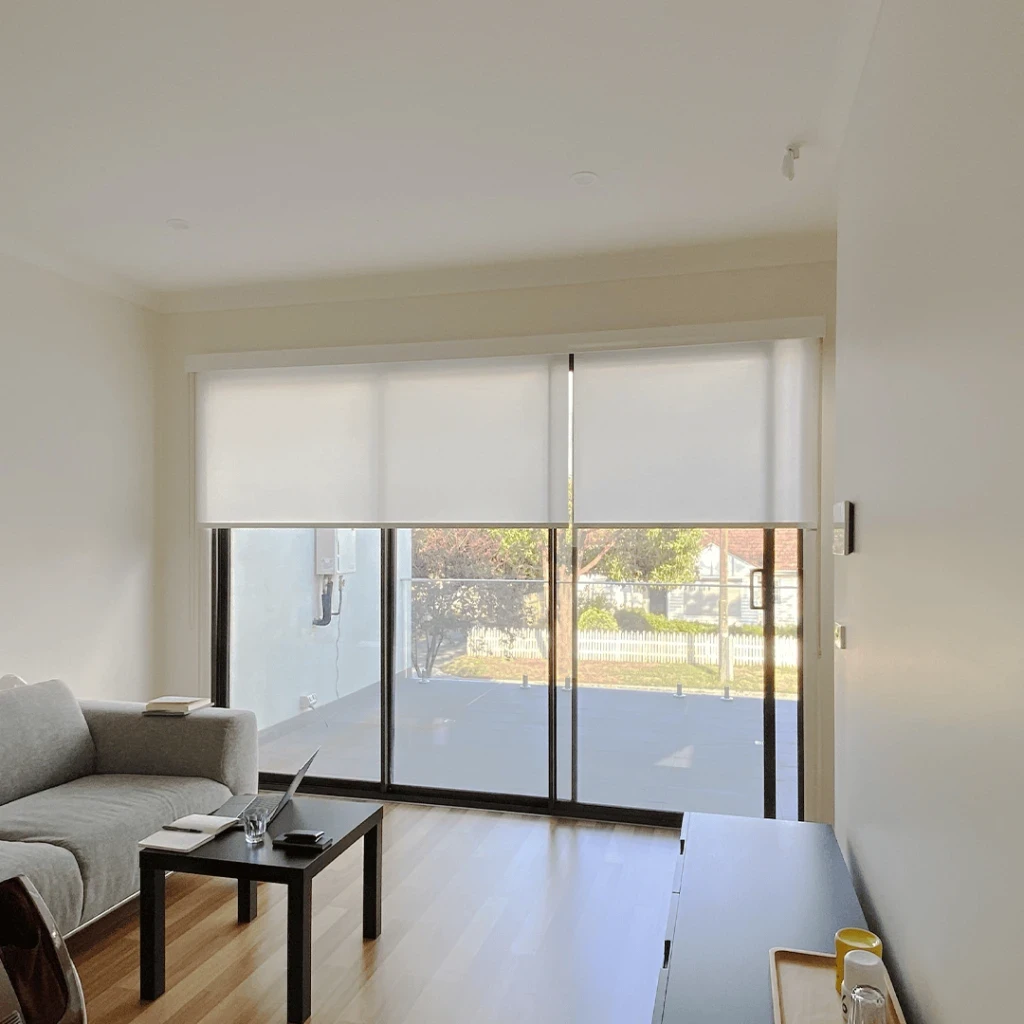
16. Large Windows and Blockout Fabric
Blockout fabric is most useful where:
- •
Night privacy matters.
- •
Bedrooms need darkness.
- •
Media rooms need stronger light control
- •
Heat through large glass is a concern.
- •
The room faces close neighbours.
The larger the window, the larger the visual effect of the blind.
When lowered across a wide opening, a blockout blind becomes a prominent surface within the room.
That makes fabric selection important. Choose performance first. Then make sure the colour works with the room.
17. Double Roller Blinds for Large Windows
Large windows sometimes need both daytime and night-time control.
That is where Double Roller Blinds can be useful.
A common combination is:
- •
Sunscreen for daytime
- •
Blockout for night
This gives you:
Daytime glare control. Daytime outlook. Night privacy. Room darkening.
For large windows, motorisation can make a double system much easier to manage.
You may choose to motorise one layer or both based on the available configuration and how often each blind is used.
18. Large Windows Need the Right Motor Size
A motor is not simply selected because a blind is motorised.
The motor needs to suit the blind size. This is particularly important with wider blinds.
The current iSeekBlinds Automate Zero Li-ion range uses different motor sizes for different width ranges.
For Automate Zero Li-ion, suitable blinds from approximately 570 mm to 2,000 mm use the Q1.1 motor.
Suitable Automate blinds from 2,001 mm to 3,000 mm use the Q2.0 motor.
This allows the motor to suit the physical demands of the blind.
When ordering through iSeekBlinds, choose the motor option appropriate for the configured blind rather than treating all motorised blinds as identical.
19. Do Larger Blinds Use More Battery?
A larger, frequently operated blind may place greater demand on its rechargeable motor.
Battery life is influenced by:
- •
Blind size
- •
Blind weight
- •
How often it operates
- •
Travel distance
- •
Number of daily movements
- •
Automated schedules
iSeekBlinds generally positions rechargeable motor battery life at around 10 to 12 months based on use.
Treat this as an approximate guide rather than a guaranteed charging interval.
A large living-room blind moving several times a day may need charging sooner than a smaller blind used only morning and night.
This is normal.
20. Think About Charging Access
Large windows can be high.
They can also sit behind:
- •
Sofas
- •
Dining tables
- •
Kitchen benches
- •
Bedheads
- •
Entertainment units
Before ordering, confirm that the motor charging point will remain safely accessible after furniture is in place.
Charging may only be required occasionally. But access still matters.
For hard-to-reach windows, consider this during the measuring stage rather than after installation.
A little planning makes long-term maintenance much easier.
For more maintenance advice, read Maintaining Motorised Blind Systems .
21. Smart Scheduling Can Be More Useful on Large Windows
Automation is most useful when a large window noticeably affects comfort, glare or privacy.
For instance:
A west-facing living room may become hot every afternoon.
A smart routine can lower the relevant blinds before the strongest sun arrives.
A bedroom with large windows can close automatically in the evening for privacy.
The advantage is consistent operation without relying on someone to remember every adjustment.
You are more likely to manage the window properly when you do not need to remember every adjustment manually.
For more on energy-related use, read Are Motorised Blinds Energy Efficient? .
22. Large Windows and Heat Control
Large glazed areas can have a major effect on room temperature.
The exact result is determined by:
- •
Window orientation
- •
Glass type
- •
External shading
- •
Fabric
- •
Blind fit
- •
Time of day
Sunscreen fabric may reduce glare and UV exposure while retaining the daytime outlook.
Blockout fabric provides stronger light control and privacy when lowered, although small installation gaps can still admit light.
Motorisation makes it easier to lower the blind before heat becomes uncomfortable.
For useful heat management, lower the blind before the glass and room have already heated up.
Do not wait until the room is already hot.
23. Large Windows and Privacy
A large glazed opening may create an equally large sightline into the home.
During the day, this can be part of their appeal.
At night, the same glass can make the room feel exposed.
Choose the fabric according to when privacy matters.
Sunscreen is designed for daytime privacy and outlook; it is not a night-time privacy fabric.
Light-filtering fabric offers visual screening, but privacy may reduce at night when interior lights are on.
Blockout provides reliable privacy when lowered, including after dark.
If you need different results at different times, consider a double roller setup.
24. Inside Mount or Outside Mount?
Large blinds can usually be installed inside or outside the window opening based on the window.
A recess fit sits within the opening for a neat, integrated appearance, provided there is enough unobstructed depth.
A face fit extends beyond the opening and can offer greater coverage.
The decision is determined by:
- •
Recess depth
- •
Window handles
- •
Door handles
- •
Light control
- •
Privacy
- •
Available fixing area
- •
Pelmet choice
For large blinds, also consider whether the mounting surface is strong and suitable.
The bracket system needs a secure fixing.
Follow the Roller Blind Measuring Guide before ordering.
25. Measure Each Section Carefully
Linked blinds require careful planning because the split affects both appearance and everyday access.
You need to decide where the split sits.
That split should usually make sense with the window or door layout.
For instance:
- •
Align it with a door mullion.
- •
Align it with the meeting point between glass panels.
- •
Avoid placing a gap directly through the most important viewing area where possible.
Measure the full width.
Then divide the opening into the individual blind widths according to the iSeekBlinds linked blind measuring instructions.
Accurate measurements and the correct allocation of each section are essential before ordering.
26. Do Not Assume Two Equal Blinds Are Always Best
A linked opening does not automatically require two equal-width blinds.
The correct split may depend on:
- •
Door position
- •
Fixed glass position
- •
Handle location
- •
Access requirements
- •
Furniture
- •
Visual balance
For instance, one section may need to be wider because it covers a fixed pane.
The other may need to align with the sliding door.
Let the door panels, mullions and access path guide the split rather than symmetry alone.
Not only symmetry.
27. The Centre Gap Matters
Linked roller blinds reduce the centre gap between two separate blinds.
A small operational gap remains between the fabrics. That clearance is necessary so each blind can operate independently. That means linked blinds are excellent for wide coverage.
But they should not be treated as one perfectly continuous sheet of fabric.
Consider where the centre gap will sit.
If possible, align it with a window frame, mullion or door junction.
Aligning the gap with an existing frame or junction makes it less visually prominent.
28. Pelmet 95 for Large Windows
iSeekBlinds Pelmet 95 is designed for suitable face-fit single and linked roller blind configurations. It cannot be used with a recess fit.
A pelmet:
- •
Conceals the roller
- •
Conceals the brackets
- •
Creates a cleaner top line
- •
Can help reduce visible light around the top
· Can help reduce visible light around the top
Pelmet 95 is available in long continuous sections, with wider applications able to use butt-joined pelmets where required.
This makes it useful for large windows, sliding doors and wider linked systems.
It can make a large blind installation feel more finished.
29. Back Roll or Front Roll?
Roll direction affects both clearance and light control on a large blind.
Back roll keeps the fabric closer to the window. This may improve light control and create a tighter appearance. Front roll moves the fabric further forward.
That may help clear:
- •
Door handles
- •
Window handles
- •
Frames
- •
Other obstructions
Check handle and frame clearance carefully before choosing front or back roll.
A handle that touches the fabric can interfere with the blind every time it moves.
Choose roll direction based on the physical window.
30. Motorised Blinds Behind Furniture
Large windows are often located behind furniture. This is another reason motorisation can be useful.
A manually controlled chain may be difficult to reach behind:
- •
Sofas
- •
Dining settings
- •
Beds
- •
Sideboards
Motorisation removes the need to reach a chain behind furniture during everyday use.
Furniture must still remain clear of the moving fabric and bottom rail.
Make sure:
- •
Fabric does not rub against the furniture.
- •
The bottom rail can move freely.
- •
Charging access remains practical.
- •
Nothing can catch the blind during operation.
Convenience still requires proper clearance.
31. Child and Pet-Friendly Operation
Motorised roller blinds provide a chain-free operating finish. That creates a cleaner and simpler window.
It can also be useful in homes with children and pets because there is no daily chain operation.
This is particularly relevant for large sliding doors and living areas where children may regularly move around the window.
The cleaner finish is also well suited to contemporary interiors.
32. Large Blinds Should Roll Smoothly
The larger the blind, the more noticeable poor tracking becomes.
A large motorised blind should:
- •
Roll evenly
- •
Remain level
- •
Clear obstructions
- •
Stop correctly
- •
Avoid drifting significantly to one side
If the fabric begins tracking to one side, stop and address the cause early.
Avoid repeatedly operating a blind that is rubbing, bunching or meeting an obstruction.
The Roller Blind Installation Guide includes troubleshooting guidance for common tracking and installation issues.
33. Installation Matters More on Large Blinds
Bracket position, level and secure fixing become even more important as blind size increases.
The brackets must be:
- •
Level
- •
Properly spaced
- •
Securely fixed
- •
Installed into a suitable mounting surface
For wider blinds, a second person can make installation easier.
One person can support the blind while the other positions it.
Take your time. A custom motorised blind should not be forced into position. Correct measuring and careful installation work together.
34. Choosing Fabric for a Large Surface
A small fabric sample can appear subtle, but the same colour has far more impact across a wide blind.
Across a 3-metre-wide blind, the same colour becomes a major part of the room.
That is why sample testing is especially important for large windows.
Use Roller Blind Fabric Samples before ordering.
Check samples beside:
- •
Wall paint
- •
Flooring
- •
Furniture
- •
Curtains
- •
Window frames
- •
Cabinetry
- •
Rugs
View them in daylight. Then artificial light. Wide blinds give colour and texture greater visual weight. Choose carefully.
35. Light Colours on Large Windows
Light-coloured blinds may help a large window feel visually quieter.
They can:
- •
Blend into light walls
- •
Suit coastal interiors
- •
Work with natural timber
- •
Keep open-plan rooms feeling bright
- •
Reduce visual weight when the blind is closed
Warm whites, neutral whites, soft greys and natural tones can work particularly well across large surfaces.
The exact choice is determined by the room. Use samples.
36. Dark Colours on Large Windows
Dark fabrics may create a stronger design statement.
They can work well with:
- •
Black window frames
- •
Media rooms
- •
Contemporary interiors
- •
Dark cabinetry
- •
Strong architectural finishes
But remember that a wide blind becomes a large dark surface when closed.
That can be exactly what you want. Or it can make the room feel heavier than expected. Test the colour before ordering.
37. Motorised Blinds for High Windows
Motorisation is particularly practical for windows that are both wide and difficult to reach.
A remote or smart control means you do not need to physically reach the control point every day.
However, charging access still matters. Think ahead.
Can you reach the motor periodically?
Will you need a ladder?
Is furniture going to block access?
The more difficult the window, the more important planning becomes.
38. One Remote for Multiple Large Blinds
Automate Zero Li-ion can be useful where several large blinds need to work together.
Compatible remotes can control multiple blinds using channels or groups.
For instance:
- •
Living room left
- •
Living room right
- •
Dining room
- •
All living blinds
Logical grouping makes a large installation much easier to use. Do not make the remote setup more complicated than necessary. Group blinds according to how you actually use the room.
39. Smart Naming for RollerIQ
If you use RollerIQ across several large windows, name the blinds clearly in your compatible smart-home system.
Good names include:
- •
Living Left
- •
Living Right
- •
Dining Door
- •
Bedroom Blockout
Poor names include:
- •
Blind 1
- •
Blind 2
- •
Blind 3
Clear names make voice control, routines and troubleshooting much easier.
This becomes increasingly important as more blinds are added to the home.
40. Consider the Complete Opening Before Ordering
Planning a large window requires more than recording its width and drop.
Look at the entire area.
Check:
- •
Mullions
- •
Sliding sections
- •
Door direction
- •
Handles
- •
Locks
- •
Recess depth
- •
Architraves
- •
Ceiling
- •
Cornices
- •
Power points
- •
Furniture
- •
Pelmet clearance
- •
Charging access
Take photos. Measure carefully. Plan where every blind and bracket will sit. Careful preparation supports a cleaner installation and more reliable operation.
41. Single vs Linked: A Simple Rule
As a general planning approach:
Choose a single motorised roller blind when the window is within the supported size and one blind suits the opening.
Choose linked roller blinds when:
- •
The opening exceeds the practical single-blind width.
- •
Independent sections make more sense.
- •
Sliding door access needs to remain flexible.
- •
The window architecture naturally suits two blinds.
Do not default to the largest possible single blind.
Two well-planned linked sections may operate and align better than one blind at the maximum width.
42. Common Mistakes to Avoid
Trying to Make One Blind Too Wide
Use linked roller blinds when the opening exceeds the single-blind limits.
Ignoring the Door Layout
The blind split should work with the way the door opens.
Choosing Motor Type Without Checking Width
Motor sizing is determined by the blind dimensions.
Forgetting Charging Access
Rechargeable motors need occasional access.
Placing the Centre Gap in the Wrong Position
Align it with frames or door junctions where possible.
Choosing Fabric from a Screen Only
Large blinds amplify colour and texture. Order samples.
Ignoring Handles
Check front or back roll requirements before ordering.
Assuming Motorisation Fixes Poor Measuring
It does not. A motorised blind still needs accurate dimensions and correct installation.
Overcomplicating Smart Automation
Use simple schedules and groups that genuinely make the room easier to manage.
Quick Large-Window Checklist
Before ordering, ask:
- •
What is the total opening width?
- •
Is one blind within the supported size?
- •
Would linked blinds work better?
- •
Is the opening a window, sliding door or stacking door?
- •
Do I need independent control?
- •
Which motor size suits the blind?
- •
Do I want sunscreen, light filtering or blockout?
- •
Do I need daytime and night-time control?
- •
Would double roller blinds make sense?
- •
Should I choose inside or outside mount?
- •
Is back roll appropriate?
- •
Do I need Pelmet 95?
- •
Are there handles or other obstructions?
- •
Can I access the charging point?
- •
Have I ordered fabric samples?
- •
Have I followed the measuring guide?
- •
Have I reviewed the installation guide?
If these questions are answered before ordering, the rest of the process becomes much easier.
Final Thoughts
Large windows deserve a window furnishing that is straightforward to use and maintain.
- •
Should I choose RollerIQ or Automate Zero Li-ion?
Motorisation is particularly useful because it removes the effort of manually operating a wide blind every day.
For suitable single windows, iSeekBlinds motorised roller blinds can cover widths up to approximately 3,000 mm.
For wider openings, linked roller blinds can extend coverage to approximately 6,000 mm using two individually controlled blinds.
RollerIQ suits homes wanting smart-home control, schedules and compatible app or voice operation.
Automate Zero Li-ion suits customers wanting reliable rechargeable remote-controlled motorisation. The right fabric then is determined by the room. Sunscreen for glare, UV control and daytime outlook. Light filtering for soft natural light. Blockout for strong privacy and room darkening.
For larger spans, do not focus only on maximum width.
Consider:
- •
Door layout
- •
Independent access
- •
Centre gaps
- •
Motor sizing
- •
Charging access
- •
Fabric choice
- •
Mounting position
- •
Roll direction
- •
Installation
A well-planned linked system can often work better than one oversized blind.
And a properly motorised large window becomes much easier to manage throughout the day.
For the broader motorisation overview, read the Complete Guide to Motorised Blinds .
For power and charging choices, see Battery vs Hardwired Motorised Blinds .
For ongoing care, see Maintaining Motorised Blind Systems .
Large windows are one of the best places to appreciate motorisation.
The bigger the blind, the more useful effortless control becomes.
FAQs